What is IVF?
In-vitro fertilization means that fertilization takes place outside the body “in a test tube.” Eggs and sperm meet in a petri dish so that the embryo can eventually be returned to the uterus. Worldwide, eight million babies have seen the light of day thanks to this method.
-
Conventional IVF
A well-dosed hormonal stimulation ensures the extraction of several oocytes and increases the chance of pregnancy.
More about IVF -
IVF Naturelle / Mini-IVF
Fewer hormones are used here, making the treatment gentler on the patient. The number of oocytes is lower and the chances of success per cycle are lower, but side effects and costs are reduced.
More about IVF Naturelle -
ICSI
This method is primarily used when sperm quality is severely limited. A single, carefully selected sperm is injected directly into the egg.
More about ICSI
When IVF is recommended
- If other treatment options (e.g. cycle monitoring, hormonal stimulation or insemination) have been unsuccessful
- In the case of limited sperm quality or low sperm counts
- If the fallopian tubes are blocked or damaged
- In the case of age-related limited fertility (e.g. from 40 years of age)
Who is IVF treatment suitable for
 Couples
IVF treatment can help couples whose desire to have children has not been fulfilled despite other methods such as hormonal stimulation or insemination.
Lesbian couples
Lesbian couples can also fulfill their desire to have children with the help of IVF – for example, with the help of donor sperm treatment.
Single women
For single women who want a child, IVF in combination with donor sperm can be a suitable option.
Women over 40
From around the age of 40, natural fertility decreases significantly. IVF can improve the chances of pregnancy here, especially with good egg quality.
Risks of IVF treatment
- Hormonal overstimulation (OHSS) & multiple pregnancy risk
- Minimal risks of malformations


Specialist assessment of IVF
Goldstandard
IVF (in-vitro fertilization) is one of the most established and successful methods in reproductive medicine worldwide. Our fertility doctors consider IVF to be the gold standard for many forms of infertility – with high success rates and long-term proven results.
Supplementary treatments & additional options
In selected cases, we use modern methods for sperm selection – such as PICSI. These methods enable the selection of the most motile and genetically intact sperm in order to improve the fertilization rate and embryo quality.
Cryopreservation enables the freezing and long-term storage of oocytes or embryos – for example, for family planning or after IVF/ICSI treatment. Remaining fertilized oocytes can be frozen in the pronuclear stage at ‑196 °C and later used for a new cycle without the need for another puncture. This shortens the treatment, protects the body and preserves fertility in the long term.
During fertility treatment, we offer psychotherapeutic support on request. This support can help to process emotional stress and mentally strengthen the treatment process – for a holistically supportive environment.
Procedure of IVF treatment
At the private center “Die Kinderwunschärztin” in Munich, we accompany you step by step through your IVF or ICSI treatment – individually, transparently and with the greatest care.
-
Cycle start & first check-up
Make an appointmentZu Beginn Ihres Zyklus erfolgen Ultraschall und Hormonuntersuchung (meist am 8.–11. Zyklustag), um den optimalen Startzeitpunkt zu bestimmen.
We wait for the start of the cycle first. Depending on your cycle length, the first ultrasound and hormone examination takes place between the 8th and 11th day of the cycle. This examination serves to assess the hormone status and the development of the follicles in order to be able to plan further treatment individually.
-
Stimulation & monitoring (8–12 days)
Die Eierstöcke werden hormonell stimuliert, damit mehrere Eibläschen gleichzeitig heranreifen.
Growth is checked regularly with ultrasound and blood tests. During the stimulation phase, which lasts about 8 to 12 days, the follicles mature through an individually tailored hormonal stimulation of the ovaries. The administration of a so-called GnRH agonist or antagonist prevents premature ovulation. Regular ultrasound and blood tests help to monitor the growth of the follicles and determine the optimal time for egg retrieval.
-
Egg retrieval (puncture)
Kurz vor dem Eisprung werden die Eizellen in einem kurzen Eingriff entnommen – meist in leichter Narkose.
When the follicles are large enough, the egg retrieval is scheduled. A special hormone injection triggers the final maturation of the oocytes. Approximately 36 hours later, the oocytes are extracted from the follicles in a small surgical procedure under ultrasound guidance. The procedure only takes a few minutes and is usually performed under short anesthesia. If there are few follicles, the puncture can also be performed without anesthesia.
-
Fertilization in the laboratory (IVF/ICSI)
Die gewonnenen Eizellen werden im Labor mit den Spermien zusammengebracht – oder bei der ICSI wird ein einzelnes Spermium direkt in die Eizelle injiziert.
On the day of egg retrieval, the partner submits his sperm sample. In the embryological laboratory, oocytes and sperm are brought together (IVF) or, in the case of ICSI, a single sperm is injected directly into the oocyte. The next day, it is checked how many oocytes have been successfully fertilized and are developing into embryos.
-
Embryo transfer (day 3 or 5)
Nach 3 bis 5 Tagen wird der Embryo in die Gebärmutter eingesetzt – ein kurzer, schmerzfreier Eingriff.
Depending on the development of the embryos, the transfer takes place on the third or fifth day after fertilization. The embryo is inserted into the uterus with a fine catheter. The procedure is painless and only takes a few minutes
-
Pregnancy test (~14 days later)
Etwa zwei Wochen nach dem Embryotransfer erfolgt der Schwangerschaftstest.
Together we will discuss the result and the next steps. The pregnancy test can be carried out after about 14 days. We will discuss the result with you and clarify the next steps. If the test is negative, we will analyze the causes and advise you individually on further options.
-
Another title
Text for treatment 2’s first item.
Make an appointment -
Fertilization (IVF/ICSI)
Lab step; We update you.
-
Egg retrieval (short outpatient)
You rest; We collect oocytes.
-
Stimulation & monitoring (10–12 days)
We tailor meds; You attend scans.
-
Personal and continuous support
With us, you will be accompanied by the same doctor from the initial consultation and diagnostics to the embryo transfer.
-
Individually tailored treatment
We offer all common IVF and ICSI procedures – from classic IVF to mini-IVF and IVF Naturelle.
-
Own laboratory
Fast results and full transparency: Our in-house hormone laboratory enables fast evaluations and clear communication.
-
Central location & flexible consultation hours
Our fertility center is centrally located in Munich – with appointments early in the morning or in the evening to relieve your everyday life

IVF success rates: Your chances of getting pregnant
According to the current IVF register, the average pregnancy rate after one treatment is 31.4%, and the birth rate is 22.5%. After four treatment cycles, the average pregnancy rate increases to approximately 66%.
The success rates are highly dependent on age: the pregnancy rates for women up to 34 years of age are on average 41%, from 35 – 39 years of age approximately 35% and for 40 – 42 year olds approximately 20%.
We would be happy to inform you individually about your chances in our fertility center.
Make an appointment
Chances of a natural pregnancy & with IVF
During your consultation, we will explain your personal chances of success in detail.
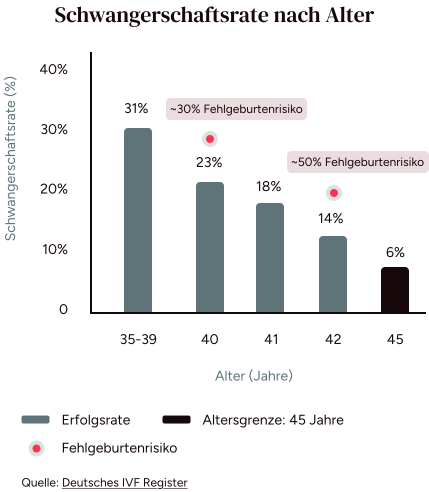
Calculate your estimation
Results based on your age
Source: German IVF Register
Read our patient testimonials
Costs: ICSI significantly more expensive than IVF
IVF treatment is technically much simpler and also cheaper. The costs of an ICSI cycle are around €6,500*, an IVF cycle costs around €3,300 (plus additional costs such as anesthesia and medication)* – a big difference. Depending on the tariff, private health insurance companies sometimes cover the complete costs. More information can be found in our cost overview.
To the cost overviewIn-vitro fertilization (IVF) includes stimulation of the ovaries, egg retrieval, fertilization in the laboratory and embryo transfer into the uterus. The basic costs include medical services and laboratory work.
IVF cycle (basic)
~€3,300
Costs for medication and anesthesia (depending on individual needs)
Make an appointmentIntracytoplasmic sperm injection (ICSI) is a further development of IVF. A single sperm is injected directly into the oocyte under the microscope – especially in the case of limited sperm quality or unsuccessful IVF.
Costs for medication and anesthesia (depending on individual needs)
Make an appointmentIn addition to the treatment costs, further expenses may arise – depending on the therapy and your individual needs. These include:
- Medication for hormonal stimulation (approx. €400 – €1,500)
- Anesthesia during egg retrieval
- Cryopreservation (freezing) of oocytes or embryos, e.g. for social freezing (storage approx. €380 / year)
The coverage depends heavily on your insurance.
Private health insurance (PKV):Depending on the tariff, many or even all treatment costs are covered if there is a medical indication (e.g. organic cause of infertility). There are usually no age limits or limitations on the number of treatment cycles.
Statutory health insurance (GKV):Since our center is a private center, the costs are generally not reimbursed by the GKV. However, those with statutory insurance can be treated as self-payers.
Please inquire in advance with your insurance company about possible reimbursements – we will be happy to support you with the application.

Frequently asked questions about IVF / ICSI
All relevant questions about artificial insemination, procedure, chances of success and next steps.
What is the difference between IVF and ICSI?
Both procedures belong to artificial insemination. In IVF (in-vitro fertilization), oocytes and sperm meet in the laboratory to fertilize naturally. In ICSI (intracytoplasmic sperm injection), on the other hand, a single sperm is injected directly into the oocyte – useful in the case of limited sperm quality or if a previous IVF was unsuccessful.
What is better – IVF or ICSI?
ICSI can improve the chances of fertilization for certain causes of infertility, but is not fundamentally more successful than IVF. Current studies (e.g. Dang et al., Lancet 2021, Boulet et al. JAMA 2015) show that the success rates are comparable with normal male fertility. However, ICSI is more expensive and should only be used if there is a medical indication.
Do women over 40 have better chances of success with ICSI?
Not necessarily. Studies show that in women over 40 years of age and normal sperm quality, there is no advantage of ICSI over IVF (Tannus et al., Hum Reprod 2017). The age of the woman, the oocyte reserve and the quality of the oocytes obtained play a much greater role in the success than the choice between IVF or ICSI. Therefore, we recommend planning the treatment individually and holistically.
Is there a natural method for IVF?
Yes, the so-called natural or mild IVF (natural cycle IVF) is a gentler variant of artificial insemination. The cycle is largely carried out without hormonal stimulation. The method is particularly suitable for women with a regular cycle, low oocyte reserve or intolerance to hormones. Since usually only one oocyte matures per cycle, the chances of success are somewhat lower than with conventional IVF. In return, the treatment is much better tolerated physically, the risk of an overstimulation syndrome is eliminated, and the egg retrieval can often be carried out without anesthesia. For many patients, natural IVF is a gentle and safe alternative that enables several treatment cycles in a row.
What happens to fertilized oocytes that are not used?
Not all fertilized oocytes are transferred immediately. Excess oocytes can be frozen in the so-called pronuclear stage and used for later transfers. This procedure is called cryopreservation and saves another egg retrieval.
How long does an IVF or ICSI treatment take in total?
The duration depends heavily on the individual requirements. From the first diagnosis to the possible pregnancy, the treatment can take several weeks to several months. The actual hormone stimulation usually comprises 8 to 12 days, during which the oocyte maturation is regularly checked by ultrasound. After the puncture and fertilization, it takes a few days to the embryo transfer – then follows the implantation phase.
Does the health insurance company cover the costs of IVF or ICSI treatment?
The coverage depends on the respective insurance company. Private health insurance companies often cover the treatment completely if there is an organic cause of infertility – even for unmarried couples. With most private tariffs, the number of attempts is not limited, provided that the expected probability of success is over 15%. Statutory health insurance companies only cover the costs partially and under certain conditions. We will be happy to support you in clarifying the reimbursement of costs with your insurance company.
What are the risks of IVF?
Possible IVF risks include hormonal overstimulation (OHSS), which depends on age, oocyte reserve and hormone dose and occurs in approximately 1–10% of women; severe forms are very rare at approximately 0.2%. The risk of multiple pregnancies depends on the number of embryos transferred and can be reduced to approximately 1% by transferring a single embryo (single embryo transfer). According to current scientific knowledge, the risk of breast cancer is not increased after IVF. The risk of malformations is approximately 2–3% for all children and approximately 4–6% for IVF/ICSI children, depending on the study; this small plus seems to be more related to the couple’s infertility than to the treatment itself.
We would be happy to advise you individually on your personal risks and additional support services such as TCM, nutritional advice or psychological support in our fertility center.
How can I support the success of fertility treatment?
A healthy lifestyle can additionally improve the chances of success. A balanced diet, taking folic acid, sufficient exercise and abstaining from nicotine and alcohol are important. Psychological stability and sufficient sleep also have a positive effect on the hormone balance and implantation. We would be happy to advise you individually on supportive measures in our fertility center.